Author: vanina

  • Democracy Talks 17: Research, society and personal development in UCE: the Utrecht University Educational Model

    17th session of the Democracy Talks, which was presented by Wieger Bakker from Utrecht University. The Democracy Talk was about university life, learning, continuing education, and the university’s educational model. The discussion also touched upon how the university embeds democratic values in its educational curricula.

    University’s Shift to Societal Education

    Wieger Bakker, a sociologist and chair in society-oriented higher education at Utrecht University, discussed the university’s shift towards more leadership positions in education and the development of continuing education. He highlighted the university’s responsibility to society and students, and the need to reassess their education to include broader societal and personal development aspects. Wieger also mentioned the establishment of four working groups to address academic qualities, society-oriented issues, teaching principles, and organizational aspects. He concluded by stating that university continuing education is a part of their primary process, including bachelor, master, and PhD education.

    University’s Educational Vision and Structure

    Bakker discussed the educational vision of their research university, emphasizing the importance of interdisciplinary projects and societal challenges. He highlighted the structure of their education, including bachelor and master programs, PhD education, and continuing education. The university’s core educational model focuses on three fields: qualification, socialization, and personal development. Bakker also mentioned the university’s graduate attributes, which include supporting a diverse, democratic, and open society. The implementation of these attributes varies between different faculties and degree programs. Lastly, Bakker emphasized the strong connection between university continuing education and their research, aiming to support alumni and professionals in their development and contribution to social issues.

    Utrecht University’s Educational Approach Evolution

    Bakker discussed the evolution of Utrecht University’s educational approach, which started around 25 years ago with a shift towards more emphasis on publications, peer reviews, and search for excellence. This led to concerns about neglecting educational quality, prompting the university to initiate different degrees and certifications for university education. This development led to more educational pathways in academic careers, educational leadership programs, and a center for academic teaching and learning. Bakker also mentioned the university’s focus on contributing to societal challenges, particularly in technology changes, sustainability, and youth issues. Diana asked about the starting point for this shift, to which Bakker explained the process of evolution and the importance of balancing research with education.

    Evolution of Educational Model Discussed

    Bakker discussed the evolution of their educational model at the center for academic teaching and learning, which started around 2.5 years ago. The model initially focused on small-scale, intensive, and activating education, but they reassessed their approach to build common ground and clarify their purpose as a university. Diana agreed, noting the shift from fixed modules to more flexible learning, which promotes critical thinking and responsibility. Karsten raised concerns about the potential for schools and universities to become more hierarchical and business-oriented, potentially undermining democratic structures.

    University Professors and Student Participation

    A participant and Bakker discussed the preparedness of university professors to teach democracy and the level of student participation in collective decision-making. The participant raised concerns about the readiness of teachers to teach democracy, while Bakker responded that the university encourages broad participation in decision-making processes through various groups and councils. Bakker also mentioned that the university’s continuing education program involves regular updates to the University Council and collects input from various faculties. The discussion ended with Bakker suggesting that courses should appreciate the diversity of students and involve them in decision-making processes to teach democracy effectively.

    Developing Critical Teaching Perspectives

    Bakker discussed the development of a critical teaching perspective at their university, emphasizing the importance of connecting research subjects with societal challenges. He highlighted the training and qualifications required for university teachers, including a 2-year basic qualification and ongoing follow-up programs. Bakker also mentioned the integration of honors education into all programs, aiming to embed this in regular degree courses. The ultimate goal is to have students actively participate in organizing their programs.

    Diverse Backgrounds in University Faculties

    Bakker discussed the varying levels of integration of diverse backgrounds in different faculties at the university, noting that it was more visible in social sciences, humanities, and international programs. Bakker also mentioned that the visibility of diverse backgrounds was more challenging in other disciplines.

    Addressing Fake News and Interdisciplinarity

    Bakker discussed the challenges of tackling fake news and promoting resilience among students at the university level. He mentioned various projects across different faculties addressing this issue, including a training program by the law department to challenge conspiracy theories. Bakker also highlighted the importance of interdisciplinary collaboration, citing examples of joint programs between humanities and sciences, and the development of a program combining humanities and life sciences. He noted that interdisciplinarity is highly valued, especially in addressing complex problems, but also emphasized the need to deliver top disciplinary students for the market. Bakker also shared an example of how interdisciplinary collaboration led to a better understanding of the consequences of urban planning decisions in the context of climate change.

    Integrating Values in Dutch Education

    Bakker discussed the importance of interdisciplinary courses in the Netherlands, which are privately financed and not allowed with public financing. Bakker emphasized the need for collective processes within institutions to integrate values like intercultural dialogue and citizenship commitment into educational curricula. Bakker also highlighted the importance of institutional entrepreneurs and the need for top-down and bottom-up approaches to engage universities in these activities.

    Questions for Reflection

    • Why did Utrecht University implement the educational model, and what was the starting point?
    • What is needed to integrate competencies for education for democracy (e.g., intercultural dialogue, citizenship commitment) into university curricula?

    Democracy Talk and Session Schedule

    Diana announced the next Democracy Talk, scheduled for February 12th, featuring Dino Siwek Co-founder of the project Terra Adentro and member of the Gesturing Towards Decolonial Futures collective. Tune in LIVE on YouTube via this link: https://www.youtube.com/@democrathorizon

  • Democracy Talks 16: INSPIRE: Co-designing more inclusive and embedded participation

    Democracy Talks 16: INSPIRE: Co-designing more inclusive and embedded participation

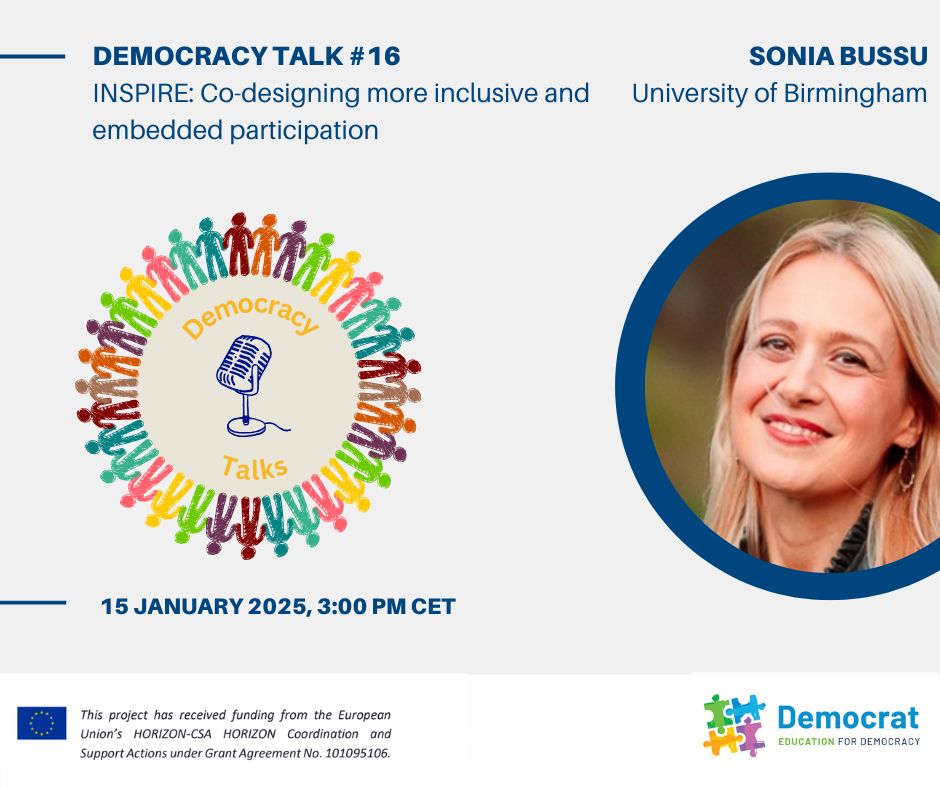
    On 15 January 2025, we had the pleasure of hosting Democracy Talk 16, where Sonia Bussu from the University of Birmingham shared her insights on the Inspire Project. This Horizon Europe initiative, running from April 2024 to March 2027, seeks to challenge the traditional top-down approach that often characterises democratic innovations in Europe. Sonia’s presentation was a compelling exploration of how we can foster more inclusive democratic spaces through genuine, participatory approaches.

    The session delved into the tensions that arise when grassroots-driven initiatives encounter the structural power imbalances embedded within our political systems. Sonia highlighted the project’s commitment to co-designing participatory spaces where the voices of the most impacted communities lead the way. Drawing from assemblage theory, the Inspire Project attempts to understand and navigate the complex interactions between diverse actors, institutions, and practices. This approach isn’t just theoretical; it plays out in real-world contexts where public officials and citizens engage in co-production models, fostering shared ownership and mutual accountability.

    One of the most captivating aspects of the project is its use of creative methods, such as Legislative Theatre and Participatory Performance Lectures. Sonia explained how these approaches move beyond traditional public consultations, providing dynamic spaces where community members don’t just discuss issues but actively co-create solutions. Legislative Theatre, for instance, allows the communities most affected by policy decisions to identify problems and collaborate directly with public officials and wider community audiences to craft meaningful solutions. Participatory Performance Lectures blend art and deliberation, creating powerful experiences that encourage deep reflection and dialogue, with the potential to influence policy decisions in tangible ways.

    However, the question remains: how do we ensure that the insights generated from these creative methods translate into actual policy changes, especially in socio-political environments resistant to non-traditional approaches? Sonia addressed this by emphasising the importance of continuous engagement with decision-makers and embedding participatory outcomes within formal institutional processes.

    Another critical theme explored during the session was intersectionality. The Inspire Project places significant emphasis on ensuring that participatory spaces are not just diverse but genuinely inclusive. Measuring the success of intersectional inclusion goes beyond theoretical frameworks and qualitative narratives. Sonia introduced the Democratic Capabilities Framework, designed to evaluate how socio-economic contexts and intersectional conditions either nurture or hinder citizen participation. Through ongoing pilot assessments and mixed-methods research, the project aims to capture the full spectrum of participant experiences, ensuring that inclusion is both meaningful and measurable.

    Reflecting on the discussion, several thought-provoking questions emerged: How can participatory projects maintain their inclusive ethos while addressing the entrenched power dynamics in policymaking? What strategies can help institutionalise creative methods like Legislative Theatre to ensure they have a lasting policy impact? How do we move beyond tokenistic gestures to embed intersectionality meaningfully in democratic innovations? And perhaps most importantly, what role can public officials play in co-creating participatory spaces without unintentionally reinforcing existing hierarchies?

    Looking ahead, we invite you to join us for the next Democracy Talk as we continue to explore innovative approaches to democratic engagement and education. Stay tuned for more enriching discussions, and don’t forget to tune in LIVE on YouTube via this link: https://www.youtube.com/@democrathorizon

  • Democracy Talks 15 Transformation and Reflection in Education for Democracy

    Democracy Talks 15 Transformation and Reflection in Education for Democracy

    On 11 December 2024, we hosted Democracy Talk 15, featuring Anne Nevgi and Niclas Sandström from the University of Helsinki. The session, titled “Transformation and Reflection in Education for Democracy,” explored how critical reflection and transformative learning can cultivate democratic competencies in both formal and non-formal educational settings.

    Key Themes Explored

    Key Competencies for Democratic Participation

    Anne Nevgi highlighted the importance of developing key competencies through education that are essential for democratic engagement:

    • Critical Reflection: Encouraging individuals to question their own biases, values, and assumptions to foster independent thinking.
    • Active Citizenship: Promoting civic responsibility and participation beyond voting, including community involvement and advocacy.
    • Social and Emotional Intelligence: Cultivating empathy, self-awareness, and emotional regulation to enhance constructive dialogue and mutual respect.
    • Metacognitive Skills: Fostering the ability to think about one’s own thinking, enabling continuous self-assessment and growth.

    Standardised Outreach Strategies for Engaging Vulnerable Communities

    The speakers addressed effective outreach strategies to engage individuals from vulnerable backgrounds:

    • Participatory Learning Environments: Creating spaces where diverse viewpoints are valued, and mutual respect is a core practice.
    • Community-Based Approaches: Establishing local platforms for youth participation in decision-making processes.
    • Social and Emotional Learning (SEL): Integrating SEL into teacher training programmes to support educators in fostering inclusive and reflective classroom environments.
    • Digital Literacy and Critical Media Skills: Equipping young people with the tools to navigate social media responsibly and recognise the impact of digital communication on democratic discourse.

    Questions for Reflection

    • How can education systems integrate critical reflection as a core component of democratic learning?
    • What strategies can schools adopt to foster active citizenship from an early age?
    • How can educators balance freedom of speech with the need to prevent hate speech in democratic societies?
    • In what ways can social and emotional intelligence be systematically incorporated into educational curricula to support democratic competencies?

    Upcoming Events

    Join us for the next Democracy Talk on 15 January 2025, featuring Sonia Bousu from the University of Birmingham. Sonia will present the Inspire Project, focusing on co-designing more inclusive and embedded participation frameworks. Stay tuned for this insightful session!

    Tune in LIVE on YouTube via this link: https://www.youtube.com/@democrathorizon

  • Democracy Talks 14: Promoting democratic participation and engagement – the AKA project

    Democracy Talks 14: Promoting democratic participation and engagement – the AKA project

    On 27 November 2024, we hosted Democracy Talk 14 featuring Hilmi Tekoglu from the SOLIDAR Foundation. Hilmi shared insights on “Promoting Democratic Participation and Engagement” through the AKA (Awareness, Knowledge, Action) Active Citizens Project. This two-year initiative, coordinated by SOLIDAR Foundation, is implemented across eight European countries—Belgium, Croatia, France, Germany, Greece, Italy, Portugal, and Spain—and funded by the Citizens, Equality, Rights, and Values (CERV) programme.

    Key Themes Explored

    Key Competencies Gained from Global Citizenship Education (GCE)

    Hilmi Tekoglu emphasised the transformative power of Global Citizenship Education (GCE) as a foundation for democratic participation. Young people engaged in GCE develop essential competencies such as:

    • Critical Thinking: Enhancing the ability to analyse, question, and understand complex social issues.
    • Empathy and Social Awareness: Fostering sensitivity to diversity, tolerance, and intergenerational solidarity.
    • Active Citizenship Skills: Encouraging participation in democratic processes, advocacy, and community-driven initiatives.
    • Environmental and Social Responsibility: Promoting climate justice, sustainable economic models, and gender equality as integral to civic engagement.

    Standardised Outreach Strategies for Engaging Vulnerable Communities

    The AKA Project adopted innovative, standardised outreach strategies to connect with young people from vulnerable backgrounds:

    • Community Centres: Co-led by youth and project partners, these centres address structural challenges through participatory methodologies tailored to local realities.
    • Training for Trainers: Involving project managers, educators, and young participants to ensure sustainable knowledge transfer and leadership development.
    • Interactive Tools and Workshops: Methods such as artivism, world café discussions, and urban mobility activities foster inclusive, engaging learning environments.
    • The AKA Booklet: A practical guide available in eight languages, offering tools and methodologies to promote transformative learning and social action.

    Questions for Reflection

    • How can Global Citizenship Education be integrated into formal and non-formal education systems to enhance democratic participation?
    • What are the best practices for ensuring that outreach strategies are inclusive and resonate with marginalised communities?
    • How can youth-led initiatives within community centres foster long-term civic engagement and leadership?
    • In what ways can educators balance transformative learning methodologies with the need for measurable outcomes in democratic participation projects?

    Upcoming Events

    Join us for the next Democracy Talk, where we will continue exploring critical themes in democratic engagement and education. Stay tuned for updates, and don’t miss out on enriching discussions!

    Tune in LIVE on YouTube via this link: https://www.youtube.com/@democrathorizon

  • Democracy Talks 13: How to Educate in a Pluralistic and Democratic Society

    Democracy Talks 13: How to Educate in a Pluralistic and Democratic Society

    Two weeks ago we spoke with Maria Rosa Buxarrais of the University of Barcelona during our Democracy Talks. Maria discussed “How to Educate in a Pluralistic and Democratic Society” in the context of higher education. The session delved into the challenges and opportunities of embedding ethical competences and democratic principles within education systems.

    Key Themes Explored

    1. The Role of Higher Education in Developing Ethical Competences
      Dr. Buxarrais highlighted the multidimensional nature of ethical education, emphasising three core areas:
      • Self-construction: Building self-awareness and regulation.
      • Living Together: Cultivating empathy, social skills, and dialogue.
      • Socio-Moral Reflection: Encouraging advanced moral reasoning.
        Higher education institutions were positioned as spaces for equipping students with professional skills and the capacity for critical thinking, commitment to justice, and active citizenship.
    2. Educational Practices that Foster Democratic Values
      Practical methods such as service-learning, problem-based learning, and restyled teaching methodologies were presented as tools to promote ethical reflection and action. Dr. Buxarrais also stressed the importance of creating institutional cultures prioritising dialogue, participation, and human dignity and rights commitment.
    3. Ethical Competence as a Foundation for Democratic Citizenship
      The session underscored the necessity of fostering moral habits, critical media literacy, and a sense of community belonging. Dr. Buxarrais noted that ethical commitment must extend beyond individual actions, encouraging students to engage in solving social problems at local, national, and global levels.

    Questions for Reflection

    • How can universities create environments that encourage dialogue, empathy, and social skills?
    • In what ways can higher education foster ethical competences that go beyond professional skills, such as commitment to justice and human rights?
    • How can primary and secondary education systems prepare students for democratic citizenship through empathy, self-regulation, and social skill development?
    • How can universities balance ethical training with the technical demands of professional fields, especially in areas where ethical dilemmas frequently arise?

    Upcoming Events
    Join us on TODAY for Democracy Talk 14, featuring Hilmi Tekoglu of SOLIDAR Foundation. He will discuss “Promoting democratic participation and engagement – the AKA project”.

    AKA (Awareness, Knowledge, Action) Active Citizens is a 2-year project, coordinated by SOLIDAR Foundation, carried out in a consortium of 8 partners across Europe namely Belgium, Croatia, France, Germany, Greece, Italy, Portugal, and Spain. The project’s primary objective is to promote democratic participation and engagement at the EU level among young citizens from marginalised/underrepresented backgrounds across the participating 8 countries. AKA Active Citizens project is funded by Citizens, Equality, Rights and Values (CERV). You can learn more here

    Don’t miss out on this enriching discussion and tune in LIVE on YouTube via this link: https://www.youtube.com/@democrathorizon

  • Democracy Talks 12: Building Democratic Foundations: Insights from Italian Schools on Civic Education

    Democracy Talks 12: Building Democratic Foundations: Insights from Italian Schools on Civic Education

    On October 30th, we had the pleasure of hosting Valeria Damiani from LUMSA University in Rome for our 12th Democracy Talk. Valeria shared her expertise on “The School as a Democratic Learning Environment: Promoting a Whole-School Approach to Civic and Citizenship Education in Italian Primary and Lower Secondary Schools.” I’d like to take a moment to reflect on Valeria’s insightful session and highlight some key themes that resonate with the goals of civic education.

    As part of our ongoing series, this talk brought in Diana Trevino, Project Officer at the European University Continuing Education Network, who introduced Valeria. Valeria, an expert in democratic education and principal investigator for the Prin 2022 project, shared valuable insights into her team’s work on fostering democratic learning environments in Italian schools, emphasizing the ‘whole-school approach.’

    In her presentation, Valeria outlined findings from her project, funded by Italy’s Ministry of Education. She discussed the challenges and opportunities for democratic learning in Italian schools, such as a gap between national civic education guidelines and school-level practices, often hindered by inconsistent reforms and a lack of dedicated support for democratic initiatives in classrooms.

    Key Themes Explored

    Inclusivity in Democratic School Culture
    Valeria stressed that schools can function as democratic learning environments where students experience citizenship through active participation in school decisions, management, and community involvement. She noted that the whole-school approach emphasizes inclusivity, allowing students to engage meaningfully and feel their voices are heard. Valeria highlighted that such participation, while familiar in upper secondary levels, is often absent in lower levels, creating a missed opportunity for fostering democratic values from an early age.

    Teaching as Democratic Practice
    Valeria shared that democratic learning also involves adopting inclusive teaching methods, where students actively engage with the learning process. Techniques such as formative assessments, peer feedback, and shared goal-setting were cited as ways to incorporate democratic principles into teaching. In this way, students gain practical experience in democracy, fostering a sense of responsibility and citizenship.

    Promoting Active Citizenship Beyond School
    The project encourages students to act within their local communities, aligning with one of the three pillars of the whole-school approach. This model connects classroom learning to real-world applications, creating a bridge between theoretical knowledge and active citizenship.

    Questions for Reflection
    To deepen your engagement with these themes, consider the following:

    • How can schools, particularly in early education, incorporate democratic practices to prepare students for active citizenship?
    • What strategies could bridge the gap between national policies and school-level civic education practices?
    • How might teachers collaborate to create democratic learning environments within the constraints of traditional subject structures?

    For those who couldn’t join, the full recording of Valeria’s talk is available on our YouTube channel. We thank Valeria and all participants for this enriching discussion, which has provided valuable insights into advancing democratic education in schools.

    Today is our 13th talk with Maria Rosa Buxarrais of the University of Barcelona. Maria will discuss “How to Educate in a Pluralistic and Democratic Society” in the context of higher education. The talk begins at 3 PM CET.

    In two weeks we will also have our talk with Hilmi Tekoglu of SOLIDAR Foundation who will speak on Promoting democratic participation and engagement – the AKA project. You can add it to your calendar here

    This project has received funding from the European Union’s HORIZON-RIA HORIZON Research and Innovation Actions under Grant Agreement No. 101095106. Views and opinions expressed are those of the author(s) only and do not necessarily reflect those of the European Research Executive Agency. Neither the European Union nor the granting authority can be held responsible for them.

  • Democracy Talks 11: Empowering Youth through Citizens’ Assemblies

    Democracy Talks 11: Empowering Youth through Citizens’ Assemblies

    By Vanina Morrison

    On October 16th, we had the pleasure of speaking with Ben Mallon from the Democrat Project about citizens’ assemblies for children and young people. I’d like to take a moment to reflect on Ben’s insightful session and highlight key themes that are important for us to remember.

    This session marked our eleventh gathering of the Democracy Talks, where we had the pleasure of hosting Diana Trevino, Project Officer at the European University Continuing Education Network, who introduced Benjamin Mellon, an expert on democratic education and youth engagement. Benjamin shared insightful perspectives on citizens’ assemblies for children and young people and their profound implications for fostering democratic education.

    Benjamin’s presentation highlighted key findings from a collaborative research project led by his team at Dublin City University, exploring the role of children’s assemblies in strengthening deliberative democracy and environmental awareness. He introduced us to a groundbreaking assembly held in Ireland, where children aged 7 to 17 gathered to address biodiversity loss. The participants engaged in activities designed to deepen their understanding of environmental challenges, leading to a shared vision of a sustainable Ireland rooted in nature and community.

    Key Themes Explored

    1. Inclusivity in Decision-Making
      Benjamin emphasized the need for inclusive, intergenerational justice, arguing that children’s perspectives are crucial in tackling global issues like biodiversity loss. This assembly provided a unique space for youth voices, which are often overlooked, to be heard. As one participant poignantly noted, “If children and young people aren’t going to be part of their own future, how can we possibly solve this?”
    2. Education and Democratic Competence
      The assembly highlighted the importance of education as a foundation for informed, collective decision-making. By learning about complex topics such as biodiversity, children gained the knowledge to participate meaningfully in democratic processes. Through collaborative activities, they practiced decision-making not only for themselves but for the community, showcasing the potential of school-based assemblies to nurture democratic competence.
    3. Action and Impact Beyond the Assembly
      The assembly inspired participants to act within their schools, communities, and even at a broader national level. One child described addressing local council leaders on environmental issues, demonstrating how these assemblies empower young people to engage in citizenship beyond the classroom.

    Questions for Reflection
    We invite you to reflect on the following questions as you consider the role of youth assemblies in democratic education:

    • Why is it essential to include children and young people in assemblies addressing issues like climate change and biodiversity?
    • How can adults and policymakers ensure that recommendations from youth assemblies are taken seriously?
    • How can youth assemblies be integrated into broader educational policies to promote democratic values?

    For those who missed the latest talk, you can catch the full recording on our YouTube channel here


    Thank you to everyone who joined us, especially Benjamin for his inspiring work on youth assemblies. Let’s continue empowering future generations to lead the way toward a democratic and sustainable future.


    Disclaimer: This project has received funding from the European Union’s HORIZON-RIA HORIZON Research and Innovation Actions under Grant Agreement No. 101095106. Views and opinions expressed are those of the author(s) only and do not necessarily reflect those of the European Research Executive Agency. Neither the European Union nor the granting authority can be held responsible for them.

  • Combating Conspiracy Narratives, Fake News, and Hate Speech in and through Education in Post-Digital Societies

    Combating Conspiracy Narratives, Fake News, and Hate Speech in and through Education in Post-Digital Societies

    By Fabian Virchow of the Hochschule Düsseldorf, HSD

    Conspiracy theories (CT) have been examined across several academic disciplines, each offering unique perspectives and methodologies. In psychology, researchers study the cognitive processes and personality traits that lead individuals to believe in conspiracy theories. This includes examining cognitive biases, such as confirmation bias and the need for closure.[i] Sociology addresses the social dynamics and group behaviours associated with conspiracy beliefs, including how social identity and group membership influence perceptions of conspiracies.[ii] Scholars in political science analyse the role of conspiracy theories in political contexts, including their impact on public opinion, political behaviour, and governance. The relationship between power, authority, and conspiracy narratives is a key focus.[iii] In the field of communication studies, the focus is on how conspiracy theories spread through media, including social media platforms. It looks at the role of misinformation and the framing of conspiracy theories in public discourse.[iv] Researchers in cultural studies examine the cultural significance of conspiracy theories, including their representation in popular culture and their role in shaping collective narratives. Historians study past conspiracy theories and their consequences, examining how historical events have been interpreted through a conspiratorial lens and the societal impact of those narratives. Anthropologists may explore how conspiracy theories manifest in different cultures and societies, analyzing their meanings and functions within specific cultural contexts. Philosophers discuss the epistemological issues surrounding conspiracy theories, including questions of knowledge, belief, and the nature of truth. Taken together, these interdisciplinary approaches contribute to a more comprehensive understanding of the complexities surrounding conspiracy theories, their impact on society and how they spread.

    A few examples might illustrate that belief in conspiracy theories is not a peripheral phenomenon. Jabkowski et al.[v] have shown that in many European countries between 20% to 30% of the population believe in COVID-19 related conspiracy theories.The Qanon CT has spread rapidly in several countries after it originated in the U.S.[vi] Also, there are several CTs around the destruction of the Twin Towers at 9/11 in New York City, the most prominent one being that it has been the result of controlled demolitions rather than structural failure due to impact and fire.[vii] Finally, it should be remembered that the antisemitic CT around the forged script The Protocols of the Elders of Zion finds resonance around the world.[viii]

    While CTs regularly include disinformation and fake news, the latter also occur without being embedded in CT. While the term misinformation should be applied to false or misleading information which is spread without malignant intention, disinformation is deliberately false information that is created and disseminated to deceive or manipulate public opinion. It is often used for political purposes, e.g. to sow public disorder or to undermine trust in political institutions.[ix] Since 2016, the term fake news has become mainstream following Donald Trump’s election as U.S. president and his modes of communication.[x] In this context, fake means hoax, forgery or simply invented issues. Accordingly, fake news isfake news dressed up as real news.

    Fake news and conspiracy theories often go along with hate speech.[xi] Nowadays, acts of hate speech have a much larger outreach thanks to the extension of the virtual sphere.[xii] Hate speech poses several significant dangers, including:

    1. Incitement to Violence: Hate speech can provoke individuals or groups to commit acts of violence against targeted communities.
    2. Normalization of Prejudice: It can legitimize discriminatory attitudes and behaviors, making it easier for intolerance to spread.
    3. Social Division: Hate speech fosters division within society, leading to an “us vs. them” mentality and exacerbating conflicts.
    4. Psychological Harm: Victims of hate speech may experience trauma, anxiety, and depression, affecting their mental well-being.[xiii]
    5. Suppression of Free Expression: In environments where hate speech is rampant, individuals may feel unsafe to express their opinions, stifling constructive dialogue.
    6. Marginalization: Targeted groups can become further marginalized, leading to decreased social and political representation.
    7. Legal Repercussions: Hate speech can lead to complex legal challenges, as laws vary widely by jurisdiction and can lead to misuse or overreach.

    Addressing hate speech requires a careful balance between protecting free expression and preventing harm to individuals and communities.

    Rejecting hate speech requires a collective effort at multiple levels. Effective strategies include that organizations, schools, and platforms should establish and enforce clear anti-hate speech policies, outlining unacceptable behaviors and consequences. Implement accessible ways for individuals to report hate speech, ensuring that complaints are taken seriously and addressed promptly. It might be useful to encourage individuals and communities to respond to hate speech with constructive counter-speech[xiv], promoting tolerance and understanding while offering resources and support for those affected by hate speech, fostering a sense of community and resilience. Regarding legal measures laws that penalize hate speech while balancing free expression rights, depending on the context and jurisdiction, are a helpful contribution as well.

    Regarding tackling CTs and fake news a multi-faceted approach that takes responsibility for a wide range of actors should include that governments and institutions should communicate transparently and consistently, especially during crises, to build trust and reduce the appeal of conspiracy theories. Social media platforms can implement stricter policies to reduce the spread of false information while balancing free speech considerations. It might also be useful, if local communities hold workshops to address specific fears and concerns, building resilience against misinformation. Such approaches should promote the use of reputable fact-checking organizations and encourage people to verify information before sharing it. In addition, credible experts and sources who can counter misinformation effectively should be highlighted, making their messages more accessible and relatable.

    Of course, schools and the education sector have a special role to play, especially with regard to young people[xv] given the intensity with which teens use social media.[xvi] Generally, this is about strengthening (news) media literacy and digital literacy.[xvii] Focusing on the role of schools and teachers, six elements are key:

    1. Media Literacy Education: Teach critical thinking and media literacy skills in schools to help individuals evaluate sources, understand bias, and identify misinformation such as those in CTs.
    2. Education and Awareness: Promote programs that educate individuals about the impact of hate speech, encouraging empathy and understanding among diverse groups.
    3. Open Dialogue: Create safe spaces for conversations about hate speech and its consequences, allowing people to share experiences and perspectives.
    4. Safer Spaces: Safe places, squares and spaces are important for many marginalized groups to protect themselves from discrimination and to exchange ideas.
    5. Be aware of the spread and depth of mistrust towards established media and political actors.[xviii]
    6. Educating the Teachers: Teachers are not immune to hate speech and fake news; they are rarely ahead of the students in terms of knowledge and application security of the latest media technologies. There is also uncertainty in dealing with the topics mentioned in this article.[xix]

    Definitions such as media/digital literacy being the ability to access, analyze, evaluate, create, and effectively communicate using various forms of (digital) media and to understand how media messages are constructed, the purpose behind them, and how they influence audiences as well as recognizing bias, distinguishing between credible and false information, and becoming an informed and responsible consumer and creator of media give some idea about the desired achievement, but are not necessarily directly helpful in class.

    For example, it makes a difference if a teacher is suddenly confronted with a student presenting conspiracy narratives or if the teacher makes CTs a subject in class by him*/her*self. In the first case, be clear that the issue is in class. Therefore, do not ignore it. Regarding your reaction as a teacher, first check if you have knowledge to address that particular CT directly. If not, do not deal with the CT, as it would open space for speculations you cannot correct or contextualize. Instead, the student(s) can be asked what the source is they refer to, request why they are interested in it. As a teacher you can explain the level of your (non-)knowledge regarding that particular CT and prepare well for dealing with the issue next time you meet the students. If you are sure that the CT is brought up for the purpose of provocation only, address it as such and ignore it.

    In the second case, select a case of general interest of which sufficient sources and material is easily available. Historical cases from the 18th to the 20th century are more easy than more recent ones as e.g. New World Order or 9/11. The aim of addressing the issue is not to refute the many CTs that are vagabonding but to educate students on how CTs are structured, why they attract the interest of people, and how they can be identified as legends. Probably add examples of real conspiracies to clearly identify the difference. Start with the historical facts, not with the CT.[xx] More generally, try to find out how deep the individual who are talking to is already inclined into CT thinking. This makes a difference in how to deal with it.[xxi]

    Hate speech is the other big issue. A longer quote might be added here from a recent publication that mirrors some of the reflections above: “1. Address the issue (do not ignore it!): Far too often, when teachers hear hate speech, there is a tendency to ignore it because they are not sure how to address it. Teachers might think, ‘I am not sure what to say’ or […] ‘It wasn’t my issue.’ Whenever hearing hate speech, teachers and leaders should immediately speak out against it, tell students that such talk and actions will not be tolerated, and be firm in such a stance. Silence on these matters is complicity, does not protect students and only gives license for more hateful language to be used in the classroom or schoolyard. 2. Research the topic or the offensive language: When caught off guard with hate language, use it as a teachable moment, for yourself and for your students. But always keep in mind that we cannot teach what we do not know. If we do not know the history of hateful language used to demean different racial/ethnic groups, women, LGBTQ+ members, people of particular religious backgrounds or people who are born in another country, then we need to learn. It is incumbent for teachers to educate themselves and study about topics, issues and language that are divisive or hateful. […] 3. Increase your own racial literacy: […] Our country’s racial, ethnic and linguistic demography is changing rapidly. Thus, teachers need to increase their racial literacy to better understand, connect with and teach today’s learners. Race-based hate crimes remain the number-one type of hate crime […]. Hate is learned, and all adults must speak out about it. […]. 4. Examine content in the curriculum: Frequently, school content and curriculum can have language, examples or images that implicitly or explicitly convey hateful messages. Teachers must be diligent in examining anything that could be controversial in textbooks, literature or videos shared in the classroom. Such content should be excluded from what students are being taught, but skilled teachers may choose to have educative discussions about why certain language is used in content and why it should be removed. 5. Generate discussion in your class around hate language: No matter the grade level or subject matter, teachers need to have conversations early and often about the zero tolerance for hate speech in their classrooms and across the school. Introduce concepts and lessons about the history of certain words and how they were used to dehumanize people. […] 6. Bring in guest speakers: One of the more powerful approaches that teachers can take to help students learn about diversity is to hear first hand from people from different groups who can talk about cultural practices, lived experiences or historical events that are age appropriate and tied to particular subject matter.“[xxii]

    Combating misinformation, hate speech, and conspiracy theories in classrooms remains a challenging but essential task that requires dedication and perseverance.


    [i] See e.g. Ted Goertzel (1999): Belief in Conspiracy Theories. Political Psychology 15(4): 731-742; Jan-Willem van Prooijen (2022): Psychological benefits of believing conspiracy theories. Current Opinion in Psychology 47: 101352.

    [ii] See e.g. Michael Barkun (2013): A Culture of Conspiracy: Apocalyptic Visions in Contemporary America. Berkeley: University of California Press; Hayagreeva Rao & Henrich R. Greve (2024): The Plot Thickens: A Sociology of Conspiracy Theories. Annual Review of Sociology 50: 191-207.

    [iii] See e.g. Roland Imhoff & Martin Bruder (2014): Speaking (un-)truth to power: Conspiracy mentality as a generalised political attitude. European Journal of Personality 28(1): 25-43; Julien Giry & Pranvera Tika (2020): Conspiracy Theories in Political Science and Political Theory. In: Michael Butter & Peter Knight (eds.) Handbook of Conspiracy Theories. London: Routledge, pp. 108-120.

    [iv] See e.g. Adam M. Enders et al. (2024): The Relationship Between Social Media Use and Beliefs in Conspiracy Theories and Misinformation. Political Behavior 45: 781-804; Matteo Cinelli (2022): Conspiracy theories and social media platforms. Current Opinion in Psychology 47: 101407.

    [v] See Piotr Jabkowski et al. (2023): Exploring COVID‑19 conspiracy theories: education, religiosity, trust in scientists, and political orientation in 26 European countries. Scientific Reports 13(1): 18116.

    [vi] See CeMAS – Center für Monitoring, Analyse und Strategie (2022): Q VADIS? The Spread of QAnon in the German-Speaking World. Berlin: CeMAS.

    [vii] See Carl Stempel et al. (2007): Media Use, Social Structure, and Belief in 9/11 Conspiracy Theories. Journalism & Mass Communication Quarterly 84(2): 353-272.

    [viii] See Esther Webman (ed.): The Global Impact of the Protocols of the Elders of Zion. London: Routledge.

    [ix] See European Parliament/DROI Subcommittee (2021): The impact of disinformation on democratic processes and human rights in the world. Brussels.

    [x] See Andrew S. Ross & Damian J. Rivers (2018): Discursive Deflection: Accusation of “Fake News” and the Spread of Mis- and Disinformation in the Tweets of President Trump. Social Media + Society 4(2): https://doi.org/10.1177/2056305118776010.

    [xi] See Mika Hietanen & Johan Eddebo (2023): Towards a Definition of Hate Speech – With a Focus on Online Contexts. Journal of Communication Inquiry 47(4): 440-458.

    [xii] See Naganna Chetty & Sreejith Alathur (2018): Hate speech review in the context of online social networks. Aggression and Violent Behavior 40: 108-118.

    [xiii] See Jeremy Waldron (2012): The Harm in hate Speech. London/Cambridge, MA: Harvard University Press.

    [xiv] See Rachel Fraser (2023): How to talk back: hate speech, misinformation, and the limits of salience. Politics, Philosophy & Economics 22(3): 315-335.

    [xv] See UNESCO (2023): Addressing hate speech through education. Paris.

    [xvi] See Heidi Mercenier et al. (2021): Teens, Social Media, and Fake News. In: Guillermo Lopez-Garcia et al. (eds.) Politics of Disinformation. Hoboken: Wiley-Blackwell, pp. 161-172.

    [xvii] See Stephanie Craft et al. (2017): News media literacy and conspiracy endorsement. Communication and the Public 2(4): 388-401; Florence Namasinga Selnes (2024): Fake news on social media: Understanding teens’ (Dis)engagement with news. Media, Culture & Society 46(2): 376-392.

    [xviii] See Ana Pérez-Escoda et al. (2021): Fake News Reaching Young People on Social Networks: Distrust Challenging Media Literacy. Publications 9: doi.org/10.3390/publications9020024.

    [xix] Maihemuti Dil Dilimulatia et al. (2024): Talking about violent extremism: Experiences of Canadian secondary school teachers in four metropolitan areas. Journal of Deradicalization 40: 72-113; Ludwig Bilz et al. (2024): Teachers’ intervention strategies for handling hate-speech incidents in schools. Social Psychology of Education online first: doi.org/10.1007/s11218-024-09929-9

    [xx] For more detailed guidance see Jeremy Hayward & Gemma Gronland (2021): Conspiracy Theories in the Classroom Guidance for teachers. London: UCL.

    [xxi] See also for more material Europan Commission: Identifying conspiracy theories online via https://commission.europa.eu/strategy-and-policy/coronovirus-response/fighting-disinformation/identifying-conspiracy-theories_en

    [xxii] Quoted from Tyrone C. Howard (2024): Equity Now. Justice, Repair, and Belonging in Schools. Thousand Oaks, CA: Corwin.
  • Democracy Talks 9 Challenging Fake News and Conspiracy Theories in Education

    Democracy Talks 9 Challenging Fake News and Conspiracy Theories in Education

    Hello everyone! Welcome back to the ninth Democracy Forum!

    Last week, on Wednesday, September 18, we had the honor of hosting Fabian Virchow from the Hochschule Düsseldorf (HSD). Fabian led an engaging and thought-provoking discussion on “Challenging Fake News and Conspiracy Theories in Education.”

    During his presentation, Fabian explored several critical themes. He highlighted how conspiracy theories and fake news impact democracy and presented a compelling overview of the structure of conspiracy narratives. Fabian emphasized that such narratives often thrive in times of crisis, offering simple explanations for complex problems, thus appealing to those feeling uncertain or anxious. He also discussed the importance of developing digital literacy and fostering critical thinking as key tools in combating misinformation within the classroom.

    We invite you to rewatch the talk here and reflect on the following questions or share your thoughts on any related aspects discussed by Fabian:

    • What are some effective strategies for helping students critically engage with fake news and conspiracy theories in educational settings?
    • How can educators balance the need to counter misinformation with the importance of upholding freedom of speech and encouraging open dialogue?
    • What role should schools play in fostering resilience against the fear and uncertainty that can make individuals more susceptible to conspiracy theories?

    We look forward to your insights and comments!

    Stay tuned for our next Democracy Talk in October, where Diana Trevino will be hosting the 10th forum. We will have a conversation with Clàudia Soler Laborda and her colleagues of the Escola Carrilet Palagrufell, Catalonia. They will speak about the project “Read Right-Read Rights: A School Project Using Children’s Rights to Develop Democratic Thinking in the Educational Community”. 

    You can subscribe to all our future talks on our YouTube page.

    Fabian has also published a blog further detailing his presentation which you can read on the Agora here. See you in a week!

  • Democracy Talks 7 Gender Inequalities: a challenge for inclusive democracy

    Democracy Talks 7 Gender Inequalities: a challenge for inclusive democracy

    Hello everyone! Welcome to the seventh Democracy forum!

    Last week, on Wednesday, July 17, we had the pleasure of hosting Paulina Sekula from Jagiellonian University in Krakow. Paulina led a compelling discussion on “Gender Inequalities: A Challenge for Inclusive Democracy.”

    During her talk, Paulina addressed several important points. She spoke on intersectionality, increasing women’s participation in leadership roles and incorporating gender equality into education for democracy.

    We invite you to rewatch the talk here and share your thoughts on these questions or any related aspects discussed by Paulina:

    1. What are some effective ways schools can promote gender equality and encourage active participation in politics from a young age?
    2. How can policies be designed to address gender inequality and other intersecting issues such as race and economic status?
    3. What strategies can be employed to increase women’s representation in various industries, particularly in leadership roles?
    4. Should gender equality be a more prominent part of education for democracy, especially given the current focus on green and digital transitions?

    We look forward to your insights and comments!

    Stay tuned for our next Democracy Talk, on July 31st where we will have a conversation with Manussos Marangudakis from the University of the Aegean. He will speak about “The Social and Political Conduct – Curricula in Primary and Secondary Education in Greece”

    You can subscribe for all our future talks on our YouTube page.