Category: Democracy Talks

  • The 5th Democracy Forum

    The 5th Democracy Forum

    Hello everyone! Welcome to the fifth Democracy forum!

    Every other Wednesday, we’ll share this online space to discuss important questions and topics that have arisen from the Democracy talks in the week before or from blog posts and current events.

    Last week, we had an enlightening 5th Democracy Talk featuring special guests Maarja Hallik and Merike Saar from Tallinn University. They presented the project “Glocally Transformative Project-Based Learning – transforming students, teachers, and communities.”

    Maarja and Merike shared their experiences with Proovikivi, an educational program that introduces project-based learning to Estonian schools. “Proovikivi” translates to touchstone or challenge in English, and its main approach is learning by doing. This initiative aims to empower learners to become locally and globally active citizens by developing specific competencies through project-based learning. You can read more about the project here.

    They addressed several key questions during their talk:

    1. What specific competencies do you aim to develop through the project-based-learning approach in order to empower learners to become locally and globally active citizens?
    2. What were some of the key challenges you faced when introducing project-based learning into diverse schools (from the teachers’ and learners’ perspectives)?
    3. In what ways do you believe that project-based learning contributes to the development of competencies that are crucial for democratic societies?

    We invite you to rewatch the talk here and share your thoughts on the following questions or anything related to the discussion with Maarja and Merike:

    1. How can project-based learning enhance the teaching of democratic competencies in schools?
    2. What are the practical challenges of implementing project-based learning in diverse educational settings?
    3. How can schools better support teachers and students in adopting project-based learning methods?
    4. What are the broader implications of project-based learning for democratic education? Any challenges or criticisms?

    We look forward to your comments and insights!

    Additionally, join us for our next Democracy Talk at 3 pm CET next week Wednesday (July 3rd) with Professor Marousos Marangudakis, who will be discussing the social and political conduct curricula in Greek schools.

    Feel free to add your comments below!
  • Welcome to the fourth Democracy forum!

    Welcome to the fourth Democracy forum!

    Hello everyone!

    Every other Wednesday, we’ll share this online space to discuss important questions and topics that have arisen from the Democracy talks in the week before or from blog posts and current events.

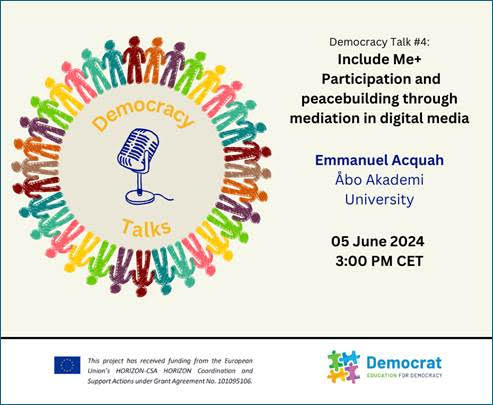
    Last week, we had an insightful 4th Democracy Talk featuring special guest Emmanuel Acquah from Åbo Akademi University in Finland.

    Emmanuel presented the project “IncludeME+: Participation and Peacebuilding through Mediation in Digital Media.” This European co-funded project aims to develop an educational program to empower higher education institutions (HEIs), media organizations, civil society organizations (CSOs), and students to become responsible and active collaborators in shaping the future of communication. The goal is to promote and establish inclusion, participation, and peacebuilding across Europe.

    Emmanuel, an Associate Professor in minority research, emphasized the importance of advancing equity in the training and practice of educators working with multicultural and multilingual learners. He also discussed how IncludeME+ addresses challenges to liberal democracy.

    Emmanuel highlighted that the outcomes of the IncludeME+ project can be beneficial for secondary school education and that its insights can enhance democratic education.

    We invite you to rewatch the talk here: https://www.youtube.com/live/adgdkEmEPxA?si=ISDUHEKIe5FcLxO3 and add your opinions on the following questions or anything related to the discussion with Emmanuel:

    1. How does IncludeME+ address the challenges to liberal democracy, such as political polarization, right-wing extremism, or the Ukraine war and its consequences?

    2. How do the educational programs and tools developed by IncludeME+ contribute to advancing human rights, gender equality, and fostering a peaceful culture?

    3. How does IncludeME+ utilize digital media to promote inclusion, participation, and peacebuilding?

    4. Are there outcomes of the IncludeME+ project that can be useful for secondary school education? Can the outcomes and insights from IncludeME+ be applied to enhance democratic education?

    5. In what ways does IncludeME+ increase participation and civic engagement, and how does this align with the goals of the Democracy project to enhance democracy through education and participatory approaches?

    Feel free to answer any of these questions or add a comment inspired by this discussion.

    Our next Democracy Talk is scheduled for Wednesday, June 19th, 2024, at 3:00 PM CET! Join us for a conversation with Maarja Hallik and Merike Saar from Tallinn University, who will present the project “Glocally Transformative Project-Based Learning – transforming students, teachers, and communities.”

  • Third Democracy Forum

    Third Democracy Forum

    Hello everyone! Welcome to the third Democracy forum.

    Every other week, we will share this online space to discuss important questions and topics that have arisen from the Democracy talks in the week before or from blog posts and current events.

    Last week, our Democracy Talk featured a special guest, Dr. Katarina Popovic from the University of Belgrade, hosted by Diana Treviño in conversation with Vanina Morrison. Dr. Popovic is a renowned expert in Adult Education, Lifelong Learning, Educational Policy, Comparative Education, and the Professionalization of Adult Education. She has made significant contributions to civil engagement and democratic rights, especially in contexts where democratic systems are less robust. You can rewatch it here: https://www.youtube.com/watch?v=k_JXsBQQQJ0&ab_channel=DemocratHorizon

    Dr. Popovic shared her insights on experiential learning and democratic education, emphasizing the need for innovative approaches to tackle global challenges. 

    Here are some questions discussed and others to spark further conversation:

    1. How can educators provide experiential learning opportunities on global issues like poverty, which may not be as prevalent in some European countries as in others?
    2. What are some effective public pedagogy methods, such as visits to government offices, that can be implemented in countries with less robust democratic systems?
    3. How can the DEMOCRAT project incorporate experiential learning to address climate change, socio-economic gaps, and geopolitical uncertainties in the EU?
    4. Can you share examples of successful implementation of experiential learning in adult education or lifelong learning programs?
    5. What challenges have you faced in promoting democratic education in your country, and how have you overcome them?
    6. How can we ensure that educational curricula are inclusive and address the gaps identified in current frameworks, particularly in fostering responsible democratic citizenship?

    Feel free to answer any of these questions or add a comment inspired by this discussion. 

    Join us next Wednesday for our fourth discussion with Emmanuel Acquah from the Åbo Akademi University in Finland.

    He will present the project “IncludeMe+: Participation and peacebuilding through mediation in digital media”. You can add it to your calendar here: https://archive.democrat-horizon.eu/event/democracy-talk-4-with-emmanuel-acquah/

  • Welcome to the second Democracy forum!

    Welcome to the second Democracy forum!

    Every other Wednesday, we’ll share this online space to discuss important questions and topics that have arisen from the Democracy talks in the week before or from blog posts and current events.

    Last week, we had an insightful 2nd Democracy Talk featuring special guest Beatriz Toscano of our German national partner team. She was joined by our host Diana Trevino of eucen. 

    Beatriz explored the intricate relationship between democratic education and parenting styles, emphasizing the critical role of emotional learning in developing democratic competencies in children. She identified three foundational elements of a healthy democracy—control, equality, and freedom—and discussed how these can be practically integrated into educational practices through an understanding of various parenting styles, including authoritarian, authoritative, permissive, and uninvolved.

    Beatriz advocated for an educational approach that integrates emotional learning and considers the familial and cultural backgrounds of students. This, she argues, is essential for cultivating a generation that not only understands democracy but practices it empathetically and effectively.

    We invite you to rewatch the talk here: https://www.youtube.com/live/Ywjr–TBojw?si=xQE9wZuPgY09k9cW and add your opinions on the following questions or anything related to the discussion with Beatrice:

    1. How can emotional learning enhance the teaching of democratic competencies in schools?
    2. In what ways do different parenting styles affect a child’s ability to learn and practice democratic values?
    3. How can schools adapt their educational approaches to better address the emotional and familial backgrounds of students?
    4. What are the broader implications of integrating emotional learning into democratic education? Any challenges or criticisms?

    Feel free to answer any of these questions or add a comment inspired by this discussion.

    Next week join us for another conversation, this time with Katarina Popović from the University of Belgrade. On Wednesday, on the 22nd of May 2024, at 3:00 PM CET we’ll be dealing the topic of “Experiential learning: Democratic education beyond traditional didactics.” You can add that to your calendars here: https://archive.democrat-horizon.eu/event/democracy-talk-3-experiential-learning-democratic-education-beyond-traditional-didactics/

  • Inaugural Democracy Forum

    Inaugural Democracy Forum

    Hello everyone! Welcome to the inaugural Democracy Forum.

    Every other Wednesday, we will share this online space to discuss important questions and topics that have arisen from the Democracy Talks in the week before, or from blog posts and current events.

    Last week, our Democracy Talk featured special guest Diana Treviño from the European Universities Continuing Education Network (EUCEN), one of the project partners for DEMOCRAT. She introduced the project and discussed how it operates, its goals, and the challenges and opportunities presented by its multinational design. Diana spoke with Vanina, the online community organizer of the Agora from FOGGS, about the importance of local pilots in the responsible democratic citizenship framework and how current curricula have gaps that need to be addressed.

    We invite you to rewatch the talk here: Democrat Horizon on YouTube and add your opinions on the following questions or anything related to the discussion with Diana:

    1. The EU faces various global challenges, including climate change, socio-economic gaps, and geopolitical uncertainties. How does the DEMOCRAT project plan to address these challenges through education?
    2. Do you have examples of successful living labs (related to the project or in general)? What approaches worked and what did not?
    3. What innovative teaching methods are currently being used in the EU to involve various stakeholders in the curriculum redesign process?
    4. How can we address linguistic and cultural differences in different national contexts regarding education for democracy?

    Feel free to answer any of these questions or add a comment inspired by this discussion.

    You can add your comments below and follow the discourse here: Democrat Horizon Discourse