Category: EN

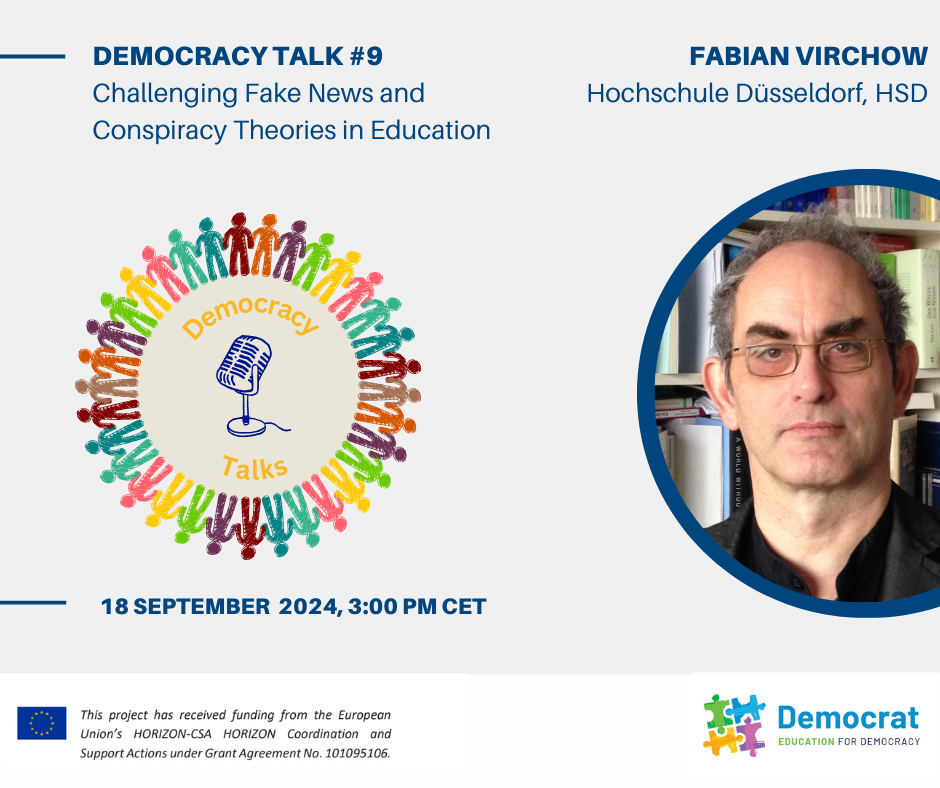
  • Democracy Talks 9 Challenging Fake News and Conspiracy Theories in Education

    Democracy Talks 9 Challenging Fake News and Conspiracy Theories in Education

    Hello everyone! Welcome back to the ninth Democracy Forum!

    Last week, on Wednesday, September 18, we had the honor of hosting Fabian Virchow from the Hochschule Düsseldorf (HSD). Fabian led an engaging and thought-provoking discussion on “Challenging Fake News and Conspiracy Theories in Education.”

    During his presentation, Fabian explored several critical themes. He highlighted how conspiracy theories and fake news impact democracy and presented a compelling overview of the structure of conspiracy narratives. Fabian emphasized that such narratives often thrive in times of crisis, offering simple explanations for complex problems, thus appealing to those feeling uncertain or anxious. He also discussed the importance of developing digital literacy and fostering critical thinking as key tools in combating misinformation within the classroom.

    We invite you to rewatch the talk here and reflect on the following questions or share your thoughts on any related aspects discussed by Fabian:

    • What are some effective strategies for helping students critically engage with fake news and conspiracy theories in educational settings?
    • How can educators balance the need to counter misinformation with the importance of upholding freedom of speech and encouraging open dialogue?
    • What role should schools play in fostering resilience against the fear and uncertainty that can make individuals more susceptible to conspiracy theories?

    We look forward to your insights and comments!

    Stay tuned for our next Democracy Talk in October, where Diana Trevino will be hosting the 10th forum. We will have a conversation with Clàudia Soler Laborda and her colleagues of the Escola Carrilet Palagrufell, Catalonia. They will speak about the project “Read Right-Read Rights: A School Project Using Children’s Rights to Develop Democratic Thinking in the Educational Community”. 

    You can subscribe to all our future talks on our YouTube page.

    Fabian has also published a blog further detailing his presentation which you can read on the Agora here. See you in a week!


  • Democracy Talks 7 Gender Inequalities: a challenge for inclusive democracy

    Democracy Talks 7 Gender Inequalities: a challenge for inclusive democracy

    Hello everyone! Welcome to the seventh Democracy forum!

    Last week, on Wednesday, July 17, we had the pleasure of hosting Paulina Sekula from Jagiellonian University in Krakow. Paulina led a compelling discussion on “Gender Inequalities: A Challenge for Inclusive Democracy.”

    During her talk, Paulina addressed several important points. She spoke on intersectionality, increasing women’s participation in leadership roles and incorporating gender equality into education for democracy.

    We invite you to rewatch the talk here and share your thoughts on these questions or any related aspects discussed by Paulina:

    1. What are some effective ways schools can promote gender equality and encourage active participation in politics from a young age?
    2. How can policies be designed to address gender inequality and other intersecting issues such as race and economic status?
    3. What strategies can be employed to increase women’s representation in various industries, particularly in leadership roles?
    4. Should gender equality be a more prominent part of education for democracy, especially given the current focus on green and digital transitions?

    We look forward to your insights and comments!

    Stay tuned for our next Democracy Talk, on July 31st where we will have a conversation with Manussos Marangudakis from the University of the Aegean. He will speak about “The Social and Political Conduct – Curricula in Primary and Secondary Education in Greece”

    You can subscribe for all our future talks on our YouTube page.

  • Updates from the Polish Living Lab

    Updates from the Polish Living Lab

    Since the last face-to-face meeting in Krakow, the Living Lab has met twice online to continue developing and discussing local pilot projects. The proposed projects address various competencies, from solidarity participation to deliberation and critical thinking, many to highlight the importance and resilience of the democratic system. Some Living Lab members will work on supporting the student council, from organizing elections to leading projects and accountability processes, to strengthen students’ voices in the school and demonstrate possibilities for social engagement. Others will organize workshops and interviews to raise awareness about student rights and different aspects of the democratic system. Some initiatives also aim to create a deliberative space for various stakeholders, including students, teachers, and parents, to collectively resolve issues affecting education in Poland and address the needs of youth.

    In May, after discussing the current phase of the project, participants were divided into breakout rooms to discuss the choice of appropriate methods to achieve the desired objectives and the participatory approach in different stages of project planning and implementation. During the online meeting in June, we invited Living Lab members to examine their projects in terms of the competencies of responsible democratic citizenship they aim to develop. The starting point for the group discussion was the list of competencies prepared during the DEMOCRAT project.

    While the local pilots are a main priority for the Living Lab currently, it still functions as a space for knowledge production and sharing, with impacts extending beyond the group. That’s why during the last transnational meeting, Anna, Olga, and Piotr (project leaders) reported on their trip to Dublin and introduced us to the local pilot projects from the partner countries they learned about. After this part of the meeting, Anna brought up the topic of the public hearing on the possible new subject of citizenship education, which some attendees had participated in. Although the subject emphasizes practice and project-based learning, concerns were raised about the lack of time to implement such a rich program and scepticism about introducing a new subject instead of integrating Education for Democracy into existing subjects (which would require more systemic and top-down solutions to encourage teachers to include such topics in their curricula).

    During the summer, the members of the Living Lab will hopefully take a well-deserved break. After the holidays, they will return to improve their projects for implementation in the next school year. Our next in-person meeting will be in Krakow.

    Written by Inga Hajdarowicz

  • The 6th Democracy Forum

    The 6th Democracy Forum

    Hello everyone! Welcome to the sixth Democracy Forum!

    Every other Wednesday, we’ll share this online space to discuss important questions and topics that have arisen from the Democracy talks in the week before or from blog posts and current events.

    Last week, we had an enlightening 6th Democracy Talk featuring special guest Georgios Kostakos from FOGGS, a partner of DEMOCRAT. He presented the project “COVID Education Alliance (COVIDEA).”

    Georgios shared insights into how COVIDEA was created in response to the significant shortcomings in our educational systems revealed by the COVID-19 pandemic. The initiative aims to address these shortcomings and help education systems adapt to the rapidly changing world, ensuring they are better prepared for digital transformations and external shocks. You can read more about the project here.

    We invite you to rewatch the talk here and share your thoughts on the following questions or anything related to the discussion with Georgios:

    1. What are the key challenges and opportunities in aligning policymakers’ goals with innovative educational practices?
    2. What steps is COVIDEA taking to ensure its digital tools and technologies protect the privacy and freedom of expression of individuals?
    3. How can technologies like virtual reality and artificial intelligence improve democratic education in schools?
    4. Should there be a recommendation to limit the use of digital technology in school settings, and is there a risk of losing humanistic competencies?

    We look forward to your comments and insights!

    Additionally, join us for our next Democracy Talk at 3 pm CET next week Wednesday (July 24th) with Paulina Sekula from the Jagiellonian University Krakow. She will speak about “Gender Inequalities: A Challenge for Inclusive Democracy.”

    Feel free to add your comments below!

  • The 5th Democracy Forum

    The 5th Democracy Forum

    Hello everyone! Welcome to the fifth Democracy forum!

    Every other Wednesday, we’ll share this online space to discuss important questions and topics that have arisen from the Democracy talks in the week before or from blog posts and current events.

    Last week, we had an enlightening 5th Democracy Talk featuring special guests Maarja Hallik and Merike Saar from Tallinn University. They presented the project “Glocally Transformative Project-Based Learning – transforming students, teachers, and communities.”

    Maarja and Merike shared their experiences with Proovikivi, an educational program that introduces project-based learning to Estonian schools. “Proovikivi” translates to touchstone or challenge in English, and its main approach is learning by doing. This initiative aims to empower learners to become locally and globally active citizens by developing specific competencies through project-based learning. You can read more about the project here.

    They addressed several key questions during their talk:

    1. What specific competencies do you aim to develop through the project-based-learning approach in order to empower learners to become locally and globally active citizens?
    2. What were some of the key challenges you faced when introducing project-based learning into diverse schools (from the teachers’ and learners’ perspectives)?
    3. In what ways do you believe that project-based learning contributes to the development of competencies that are crucial for democratic societies?

    We invite you to rewatch the talk here and share your thoughts on the following questions or anything related to the discussion with Maarja and Merike:

    1. How can project-based learning enhance the teaching of democratic competencies in schools?
    2. What are the practical challenges of implementing project-based learning in diverse educational settings?
    3. How can schools better support teachers and students in adopting project-based learning methods?
    4. What are the broader implications of project-based learning for democratic education? Any challenges or criticisms?

    We look forward to your comments and insights!

    Additionally, join us for our next Democracy Talk at 3 pm CET next week Wednesday (July 3rd) with Professor Marousos Marangudakis, who will be discussing the social and political conduct curricula in Greek schools.

    Feel free to add your comments below!

  • Welcome to the fourth Democracy forum!

    Welcome to the fourth Democracy forum!

    Hello everyone!

    Every other Wednesday, we’ll share this online space to discuss important questions and topics that have arisen from the Democracy talks in the week before or from blog posts and current events.

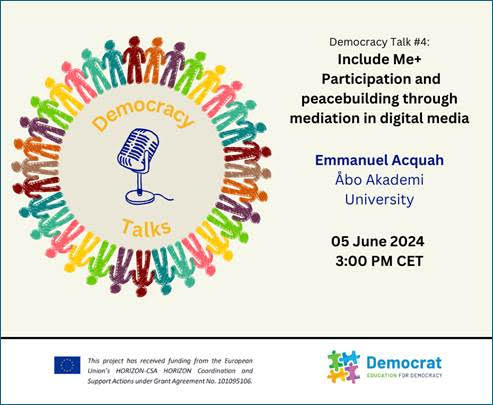
    Last week, we had an insightful 4th Democracy Talk featuring special guest Emmanuel Acquah from Åbo Akademi University in Finland.

    Emmanuel presented the project “IncludeME+: Participation and Peacebuilding through Mediation in Digital Media.” This European co-funded project aims to develop an educational program to empower higher education institutions (HEIs), media organizations, civil society organizations (CSOs), and students to become responsible and active collaborators in shaping the future of communication. The goal is to promote and establish inclusion, participation, and peacebuilding across Europe.

    Emmanuel, an Associate Professor in minority research, emphasized the importance of advancing equity in the training and practice of educators working with multicultural and multilingual learners. He also discussed how IncludeME+ addresses challenges to liberal democracy.

    Emmanuel highlighted that the outcomes of the IncludeME+ project can be beneficial for secondary school education and that its insights can enhance democratic education.

    We invite you to rewatch the talk here: https://www.youtube.com/live/adgdkEmEPxA?si=ISDUHEKIe5FcLxO3 and add your opinions on the following questions or anything related to the discussion with Emmanuel:

    1. How does IncludeME+ address the challenges to liberal democracy, such as political polarization, right-wing extremism, or the Ukraine war and its consequences?

    2. How do the educational programs and tools developed by IncludeME+ contribute to advancing human rights, gender equality, and fostering a peaceful culture?

    3. How does IncludeME+ utilize digital media to promote inclusion, participation, and peacebuilding?

    4. Are there outcomes of the IncludeME+ project that can be useful for secondary school education? Can the outcomes and insights from IncludeME+ be applied to enhance democratic education?

    5. In what ways does IncludeME+ increase participation and civic engagement, and how does this align with the goals of the Democracy project to enhance democracy through education and participatory approaches?

    Feel free to answer any of these questions or add a comment inspired by this discussion.

    Our next Democracy Talk is scheduled for Wednesday, June 19th, 2024, at 3:00 PM CET! Join us for a conversation with Maarja Hallik and Merike Saar from Tallinn University, who will present the project “Glocally Transformative Project-Based Learning – transforming students, teachers, and communities.”

  • Advancing Democratic Education: Key Takeaways from the 2-Day Transnational DEMOCRAT Workshop in Dublin

    Advancing Democratic Education: Key Takeaways from the 2-Day Transnational DEMOCRAT Workshop in Dublin

    Overview of the Transnational DEMOCRAT Workshop

    The recent Transnational DEMOCRAT Workshop, hosted at Dublin City University (DCU) from June 6-7, 2024, aimed to enhance democratic education across Europe by bringing together educators, researchers, and policymakers to discuss and refine strategies for promoting democracy through education. This workshop, funded by the European Union’s HORIZON-CSA HORIZON Coordination and Support Actions under Grant Agreement No. 101095106, showcased innovative approaches and fostered collaborative efforts to enhance democratic competencies in educational settings.

    Day 1 Recap: Thursday, June 6

    Innovative Sessions on Democratic Education

    The first day was packed with sessions focused on advancing democratic education through various innovative approaches. The event commenced with a warm welcome address by Professor Charlotte Holland, Deputy Dean of DCU’s Institute of Education. Following this, the Irish team laid out the day’s agenda, ensuring participants were well-prepared for the collaborative sessions ahead.

    The morning was structured into three parallel group sessions, each focusing on different aspects of democratic education:

    Group 1: Teacher Training and Environmental Education

    • Teacher Training: Emma Kostiainen, Saara Tujula, and Matti Rautiainen from the University of Jyväskylä, Finland, discussed innovative methods in teacher training.
    • No Democracy Without…: Piotr Walda presented on the fundamental elements necessary for democracy.
    • Environmental Delegates: Joan Martorell Masó from UB & Notus in Spain emphasized the role of environmental education in fostering democratic values.
    • Education that Supports Democracy: A video presentation by Tallinn University, Estonia, showcased diverse perspectives on integrating democratic principles in education.

    Group 2: Literacy and Human Rights in Education

    • Read Right – Read Rights: Claudia Soler Laborda from UB & Notus in Spain highlighted literacy as a cornerstone of democratic engagement.
    • Human Rights and Democracy: Olga Klotz presented on the intersection of human rights education and democratic participation.
    • And the Story is…: Graham Carroll and the Irish team discussed narrative techniques in teaching democracy.
    • Project-Based Learning Example from Estonia: Maarja Hallik from Tallinn University shared a practical example of project-based learning that supports democratic education.

    Group 3: Interdisciplinary Approaches to Democracy

    • Interdisciplinary Project KAOS: Gemma Saladrigues Roselló from UB & Notus in Spain explored interdisciplinary approaches to democracy education.
    • School Participatory Budgeting: Anna Dela discussed how participatory budgeting in schools can teach democratic processes.
    • Empathy in Action: Derek Cleary and the Irish team presented on the importance of empathy in democratic education.
    • Opinion Line: Maarit Jõemägi from Tallinn University introduced a platform for student opinions and democratic engagement.
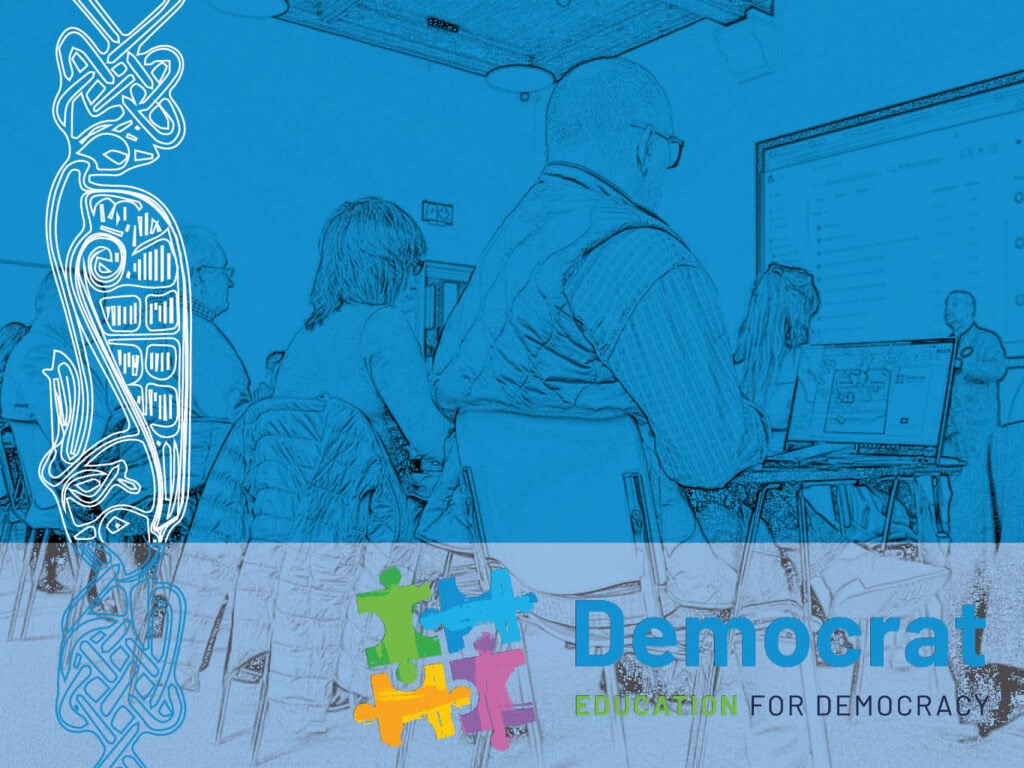
    Participants engaging in the Transnational DEMOCRAT Workshop focused on democratic education

    Afternoon Activities: Enhancing Democratic Education Projects

    The afternoon was dedicated to refining projects that promote democratic education. After a refreshing coffee break, participants reconvened in their parallel groups to fine-tune their projects. This session allowed for deeper discussions and refinement of ideas, ensuring that each project was well-developed and ready for presentation.

    Project Showcases and Feedback

    Participants presented their projects aimed at fostering democratic education. Post-lunch, each group’s lead or spokesperson presented their refined projects to the entire workshop. These presentations were divided into two sessions, with feedback from rapporteurs enhancing the collaborative process.

    • First Session: The first six projects were presented and discussed.
    • Second Session: The remaining projects were shared, followed by a feedback session.

    Keynote Insights on Democratic Education

    Keynote speakers emphasized the importance of integrating democratic education in schools. The day concluded with insightful discussions led by Dr. Aidan Clifford, who related the projects to the Council of Europe’s Framework of Democratic Competences. This was followed by a talk from Professor Amelia Lopes, an international advisor to the DEMOCRAT project, who shared her expertise on civic education and educational reform in Portugal.

    DCU All Hallows Campus Purcel House, a key location for the Transnational DEMOCRAT Workshop on democratic education

    Evening Networking and Social Events

    Participants had the opportunity to unwind and network further during a voluntary dinner at a local restaurant, followed by social drinks at a nearby pub.

    Future Outlook

    The Transnational DEMOCRAT Workshop in Dublin provided a rich platform for exchange and collaboration. It underscored the importance of integrating democratic principles into education and showcased a variety of innovative approaches from across Europe. As the projects continue to evolve, they hold the promise of fostering more democratic, inclusive, and engaged communities.

    Originally published on https://democrat-horizon.eu/advancing-democratic-education-key-takeaways-from-the-2-day-transnational-democrat-workshop-in-dublin/

  • Third Democracy Forum

    Third Democracy Forum

    Hello everyone! Welcome to the third Democracy forum.

    Every other week, we will share this online space to discuss important questions and topics that have arisen from the Democracy talks in the week before or from blog posts and current events.

    Last week, our Democracy Talk featured a special guest, Dr. Katarina Popovic from the University of Belgrade, hosted by Diana Treviño in conversation with Vanina Morrison. Dr. Popovic is a renowned expert in Adult Education, Lifelong Learning, Educational Policy, Comparative Education, and the Professionalization of Adult Education. She has made significant contributions to civil engagement and democratic rights, especially in contexts where democratic systems are less robust. You can rewatch it here: https://www.youtube.com/watch?v=k_JXsBQQQJ0&ab_channel=DemocratHorizon

    Dr. Popovic shared her insights on experiential learning and democratic education, emphasizing the need for innovative approaches to tackle global challenges. 

    Here are some questions discussed and others to spark further conversation:

    1. How can educators provide experiential learning opportunities on global issues like poverty, which may not be as prevalent in some European countries as in others?
    2. What are some effective public pedagogy methods, such as visits to government offices, that can be implemented in countries with less robust democratic systems?
    3. How can the DEMOCRAT project incorporate experiential learning to address climate change, socio-economic gaps, and geopolitical uncertainties in the EU?
    4. Can you share examples of successful implementation of experiential learning in adult education or lifelong learning programs?
    5. What challenges have you faced in promoting democratic education in your country, and how have you overcome them?
    6. How can we ensure that educational curricula are inclusive and address the gaps identified in current frameworks, particularly in fostering responsible democratic citizenship?

    Feel free to answer any of these questions or add a comment inspired by this discussion. 

    Join us next Wednesday for our fourth discussion with Emmanuel Acquah from the Åbo Akademi University in Finland.

    He will present the project “IncludeMe+: Participation and peacebuilding through mediation in digital media”. You can add it to your calendar here: https://archive.democrat-horizon.eu/event/democracy-talk-4-with-emmanuel-acquah/

  • Welcome to the second Democracy forum!

    Welcome to the second Democracy forum!

    Every other Wednesday, we’ll share this online space to discuss important questions and topics that have arisen from the Democracy talks in the week before or from blog posts and current events.

    Last week, we had an insightful 2nd Democracy Talk featuring special guest Beatriz Toscano of our German national partner team. She was joined by our host Diana Trevino of eucen. 

    Beatriz explored the intricate relationship between democratic education and parenting styles, emphasizing the critical role of emotional learning in developing democratic competencies in children. She identified three foundational elements of a healthy democracy—control, equality, and freedom—and discussed how these can be practically integrated into educational practices through an understanding of various parenting styles, including authoritarian, authoritative, permissive, and uninvolved.

    Beatriz advocated for an educational approach that integrates emotional learning and considers the familial and cultural backgrounds of students. This, she argues, is essential for cultivating a generation that not only understands democracy but practices it empathetically and effectively.

    We invite you to rewatch the talk here: https://www.youtube.com/live/Ywjr–TBojw?si=xQE9wZuPgY09k9cW and add your opinions on the following questions or anything related to the discussion with Beatrice:

    1. How can emotional learning enhance the teaching of democratic competencies in schools?
    2. In what ways do different parenting styles affect a child’s ability to learn and practice democratic values?
    3. How can schools adapt their educational approaches to better address the emotional and familial backgrounds of students?
    4. What are the broader implications of integrating emotional learning into democratic education? Any challenges or criticisms?

    Feel free to answer any of these questions or add a comment inspired by this discussion.

    Next week join us for another conversation, this time with Katarina Popović from the University of Belgrade. On Wednesday, on the 22nd of May 2024, at 3:00 PM CET we’ll be dealing the topic of “Experiential learning: Democratic education beyond traditional didactics.” You can add that to your calendars here: https://archive.democrat-horizon.eu/event/democracy-talk-3-experiential-learning-democratic-education-beyond-traditional-didactics/

  • Inaugural Democracy Forum

    Inaugural Democracy Forum

    Hello everyone! Welcome to the inaugural Democracy Forum.

    Every other Wednesday, we will share this online space to discuss important questions and topics that have arisen from the Democracy Talks in the week before, or from blog posts and current events.

    Last week, our Democracy Talk featured special guest Diana Treviño from the European Universities Continuing Education Network (EUCEN), one of the project partners for DEMOCRAT. She introduced the project and discussed how it operates, its goals, and the challenges and opportunities presented by its multinational design. Diana spoke with Vanina, the online community organizer of the Agora from FOGGS, about the importance of local pilots in the responsible democratic citizenship framework and how current curricula have gaps that need to be addressed.

    We invite you to rewatch the talk here: Democrat Horizon on YouTube and add your opinions on the following questions or anything related to the discussion with Diana:

    1. The EU faces various global challenges, including climate change, socio-economic gaps, and geopolitical uncertainties. How does the DEMOCRAT project plan to address these challenges through education?
    2. Do you have examples of successful living labs (related to the project or in general)? What approaches worked and what did not?
    3. What innovative teaching methods are currently being used in the EU to involve various stakeholders in the curriculum redesign process?
    4. How can we address linguistic and cultural differences in different national contexts regarding education for democracy?

    Feel free to answer any of these questions or add a comment inspired by this discussion.

    You can add your comments below and follow the discourse here: Democrat Horizon Discourse